
Former Train Station and Restaurant in Waynoka OK
Santa Fe Depot and Harvey House, Waynoka Oklahoma


- Categories:
- Oklahoma
- Railroad Facility
- Restaurant
- Passenger Station
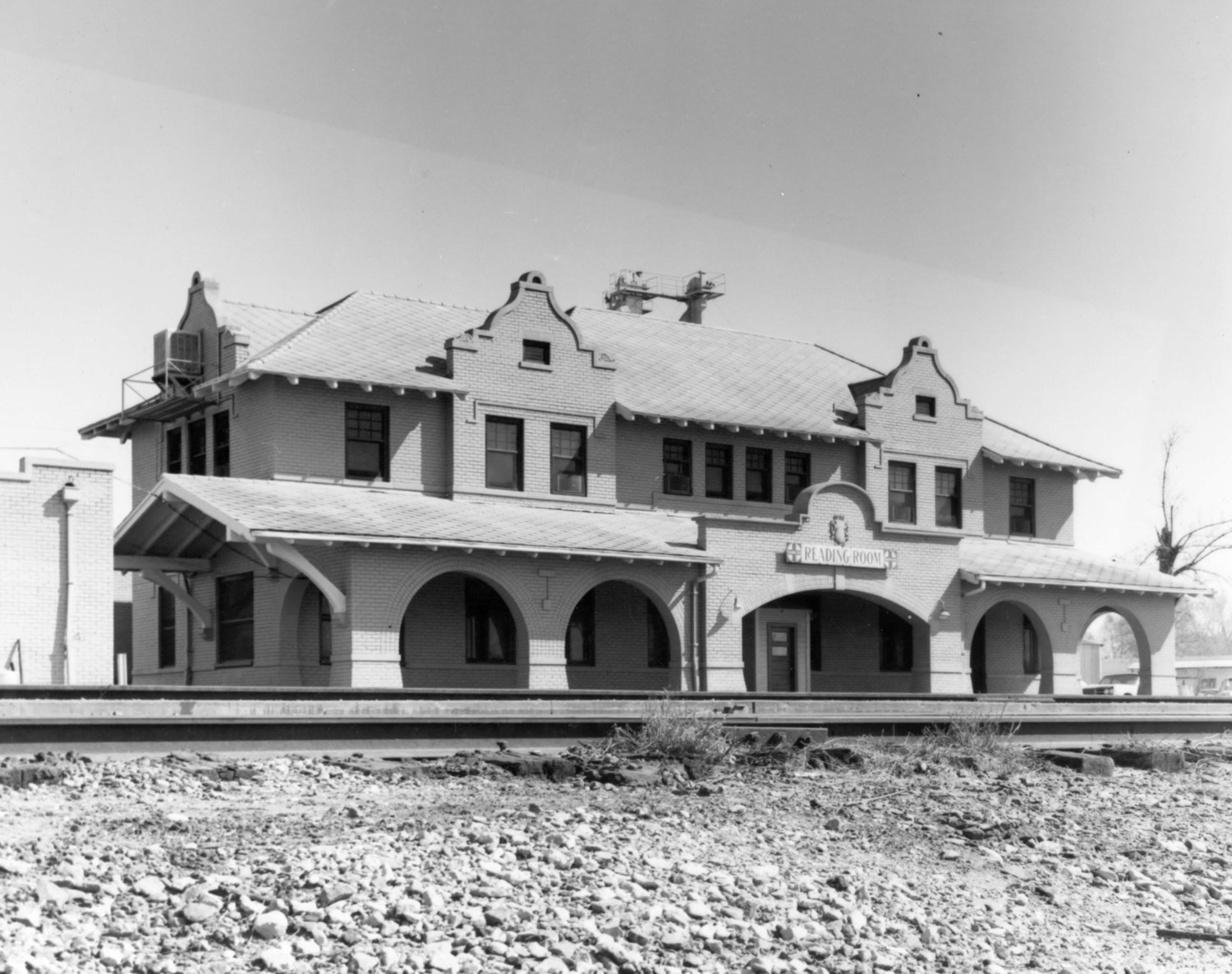
The Santa Fe Railroad Station and adjacent Harvey House were constructed in 1910, and the Harvey House closed in 1937. Excellent examples of design, the buildings were even more significant for their association with Amelia Earhart & Charles Lindberg's Transcontinental Air Transport (TAT), a rails/air route across the US. This unique, pioneering transcontinental service combined air and rail transport in conjunction with the Santa Fe railroad. While the TAT was in operation for only a short time, it set the stage for an expanded, all air service. TAT later became TWA airline.
The Waynoka Santa Fe Depot and Harvey House, apart from their success on their own from 1910-1937, were an integral part of the TAT service.
On August 7th, 1929, Charles A. Lindbergh, the national hero, sat in the office of the California Governor C.C. Young and sent a telegraph message across the nation to start the Pennsylvania Railroad's "Airway Limited" puffing out of New York station. A band played "California, Here I Come" and twenty pioneer ticket holders thus began, at 6:05 p.m., a unique and epochal transcontinental trek.
The next morning, they arrived in Columbus, Ohio, and were transported to a plush Ford Tri-Motor airplane for a flight to far-off Oklahoma. En route, possibly as much to quiet their lingering fears as to still the stirring pangs of hunger, they were offered such things as tea, hot consommé, and strawberry shortcake. The placemats are reported to have been lavender, the flatware gold-plated. Arriving in Waynoka, Oklahoma, at 6:24 p.m., they were taken to one of Fred Harvey's famed "Houses," and served a good meal by the equally famed Harvey Girls. Then they were put aboard the Santa Fe Railway's "The Missionary," for an overnight passenger train run to Clovis, NM. Here they were again tri-motored to Los Angeles, California, arriving at 5:52 p.m. The trip across the continent had required a total of 48 hours and $351. Meanwhile, 20 hardy travelers were duplicating the feat from Los Angeles to New York.
Transcontinental Air Transport, Inc., TAT, was formed under the direction of Col. Lindbergh. Its new service, more than halving the 100-hour all-rail travel time between New York and Los Angeles, was a popular success. On December 20th, 1929, it was extended to San Francisco.
A new record was set on January 31st, 1930, when 79 persons flew between Waynoka and Columbus, calling for the use of an extra aircraft.
Col. and Mrs. Lindbergh, with Amelia Earhart, came to Waynoka on April 11th, in connection with the introduction of a Curtiss Condor to the run. On September 19th, it was a new 14-passenger Tri-Motor Fokker. Then on October 10th TAT and Western Air Express joined to make better use of their air mail contracts and TWA, Trans World Airlines, came into being. On October 17th it was all over, so far as Waynoka was concerned. Transcontinental Western Airlines suspended service on this route, and opened a new route from Kansas City to Tulsa, Oklahoma City, and Amarillo.
The new Waynoka airport was kept open by TWA for a time as a weather station. After this service was transferred to nearby Gage, the field stood vacant. During World War II, it was used as an auxiliary field for air bases in northwestern Oklahoma. After the war, its last structure, a $250,000 hangar, was sold and removed to the Little Rock Municipal Airport. The site is now a wheat field.
Property Description
The Santa Fe Depot and (present) Reading Room (originally the Harvey House) sit side by side on the east side of the Santa Fe main line tracks on the west edge of the Waynoka business district. Substantial brick structures, they were built in 1910. The Harvey House was closed in 1937, remodeled in 1949 to serve as a dormitory and reading room for crewmen laying over at this important division point.
The depot itself is a long, narrow, one-story building, 84 feet long parallel to the tracks and 22 feet wide. Offices are in the bayed center. Adjacent to these, on the north, are the waiting room for train crews and the freight room. The room on the south is for electrical equipment and storage.
The Harvey House/Reading Room adjacent to the depot is a roughly H-shaped two-story structure, 95 feet north/south parallel to the tracks and approximately 100 feet east/west. A 15-foot porch faces the tracks the full width of the building. Behind this was the main Harvey House dining room, now converted to a reading room and lounge. There is a locker room on the south. Behind, utilizing space once needed for kitchens, trainmen's dining area, and other uses, are rooms for showers, a laundry, the furnace, and the librarian's quarters. Upstairs, where the Harvey Girls once stayed, there are now dormitory rooms for crewmen laying over between runs.
Though utilization of the space has changed, the two buildings remain essentially unaltered. The Reading Room, for example, still possesses such Harvey House niceties as high-ceiling rooms with exposed beams, leaded glass transoms and polished woodwork.
Harvey House from the West (1974)


