Maryland

Charles E. Cassell (1838-1916) Baltimore, Maryland (F.A.I.A.)
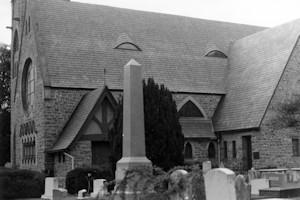
A charter memeber of the Baltimore Chapter, A.I.A., Mr. Cassell, during many years of practice was known to have designed a number of varied types of buildings. He was architect of Bishop Cumming's Memorial Church at Carrolton Avenue and Lanvale Street, Baltimore, built in 1887. He also designed Christ Episcopal Church at Cambridge Maryland.
Charles E. Cassell was born in Portsmouth, Virginia, the son of Charles E. Cassell and Sarah W. Cassell. The family, whose name had originally been Casselli, had emigrated from Genoa, Italy, to Norfolk, Virginia, in the 1820s. Charles E. Cassell was educated in Virginia, studying engineering at the University of Virginia. He fought in the Confederate Army for all four years of the Civil War, eventually serving as a captain in the Engineers' Corps under General Pickett. He was charged with treason for removing his plans for the naval waterworks at Old Point Comfort, Virginia, to keep them from falling in the hands of the Union. At the end of the Civil War he fled to Chile to avoid execution. He spent two years in Chile, becoming an ensign in the Chilean Navy, before the U.S. pardoned him. In the brief period before his arrival in Baltimore in 1868, Cassell appears to have returned to Virginia, to marry Sally Bowles, the daughter of a prominent Episcopal clergyman.
Cassell, who just two years after his arrival in Baltimore was one of the founders of that city's local American Institute of Architects chapter in 1870, was clearly an obvious candidate to design Samuel Posner's new department store. In addition to his engineering and structural expertise, he possessed strong connections to both the business and religious establishments of the city. Cassell created a retail confection whose image so quintessentially embodies an era in Baltimore history that Barry Levinson filmed its imaginary destruction to convey the end of an age of innocence in his movie Avalon.
Cassell moved to Baltimore with his wife in 1868, where they took over the residence of Cassell's brother at 1407 Park Avenue, the home in which Cassell remained until his death in 1916. They had three daughters, Mary Virginia, Sally Primrose, and Matty, as well as a son, John, who became an architect and practiced with his father from about 1904 until his premature death from flu in ca. 1909. Mrs. Cassell also died suddenly in a flu epidemic, ca. 1895-1900, and several maiden aunts from Norfolk had taken turns caring for the children, commuting on the Bay Line steamer. Anecdotal history of Cassell's career and family is taken from Peter Kurtze interview with Richard B. Carter, grandson of Charles Cassell, September 17th, 1991.
Cassell enjoyed other patronage within the close-knit and competitive world of Baltimore retailing, designing a house for Albert Hutzler and the Bernheimer Annex on Fayette Street. Information from a handout from the Baltimore AIA Centennial Exhibition.