Ohio

Peirce Anderson (2/20/1870-2/19/1924) Chicago, Illinois
One of Chicago's noted architects of the early 20th century, a member of the firm of Graham, Anderson, Probst & White for several years. Born at Oswego, New York, he received an academic education at Harvard College, and after he graduated at the age of twenty-two, went to Baltimore to enter John Hopkins College for a post-graduate course in Electrical Engineering. Doubtful, however, that he should make his career in the field of work, Anderson went to Chicago to confer with Daniel Burnham, then at the height of his fame. An excellent judge of men, Mr. Burnham advised him to take up architecture, go to Paris, and enter the Ecole des Beaux Arts, which he did. He passed the entrance examination at the first attempt, and in 1894, became a member of the Atlier Paulin. He continued his studies there for four years, and after receiving his diploma in 1899, stated on a leisurely tour of the Continent, visiting Italy, France, and Spain. Returning to the U.S. the following year, he went directly to Chicago to enter the office of D.H. Burnham & Company. Skilled in draftsmanship, he was soon made Chief Designer, and continued in the post until Mr. Burnham died. In 1903, he accompanied Mr. Burnham to the Philippine Islands, laid out the summer capitol of Baguil, and prepared plans for the development of Manila.
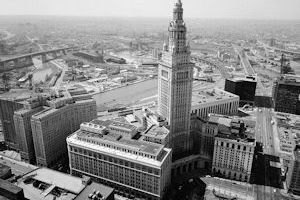
Following Burnham's death in 1912, Anderson joined Ernest Graham in organizing the firm of Graham, Anderson & Company to carry on the work of the office. Later this was superseded by Graham, Anderson & White, with the late Edward Probst and Howard Jusdon White, new members of the firm. In the busy years that followed, the drafting staff at times numbered as many as two hundred men, while Mr. Anderson continued as head of the Department of Design. It is not possible to assign specific buildings as entirely his design, as no doubt many of them were planned by capable assistants; however, during the long period Mr. Anderson was in charge of and responsible for all the work of the office, it is sage to say that the following buildings in Chicago were definitely his in concept and design: the Gas Company Building; Insurance Building at La Salle and Adams; Continental and Commercial Bank and Office Building; Stevens Building; Butler Brothers Warehouse; Wrigley Tower and Annex; Federal Reserve Bank and Office Building; Illinois Merchants Bank and Office Building; Union Station 1924 Building; Strauss Building, completed after Mr. Anderson's death. He was also particularly identified with the planning and execution of many of the firm's outstanding work in other cities. Among these the Union Station at Washington, D.C., begun in 1902 and completed six years later, was considered his greatest achievement in architecture. Other notable buildings were the General Post Office at Washington; Frisco Terminal at New Orleans; Office Building at 80 Maiden Lane, New York; Equitable Building, New York; Federal Reserve Banks at Detroit and Oklahoma City, and the Union Trust Building, Cleveland, one of his last executed works.
After Mr. Burnham's death in 1912, President Taft appointed Anderson to fill the place left vacant on the Fine Arts Commission, where he served with the other two members, Frederick Olmsted and Augustus St. Gaudens.