Milk Bottle Grocery - Triangle Barbecue/Triangle Grocery & Market, Oklahoma City Oklahoma


- Categories:
- Oklahoma
- Retail
- Roadside Attraction
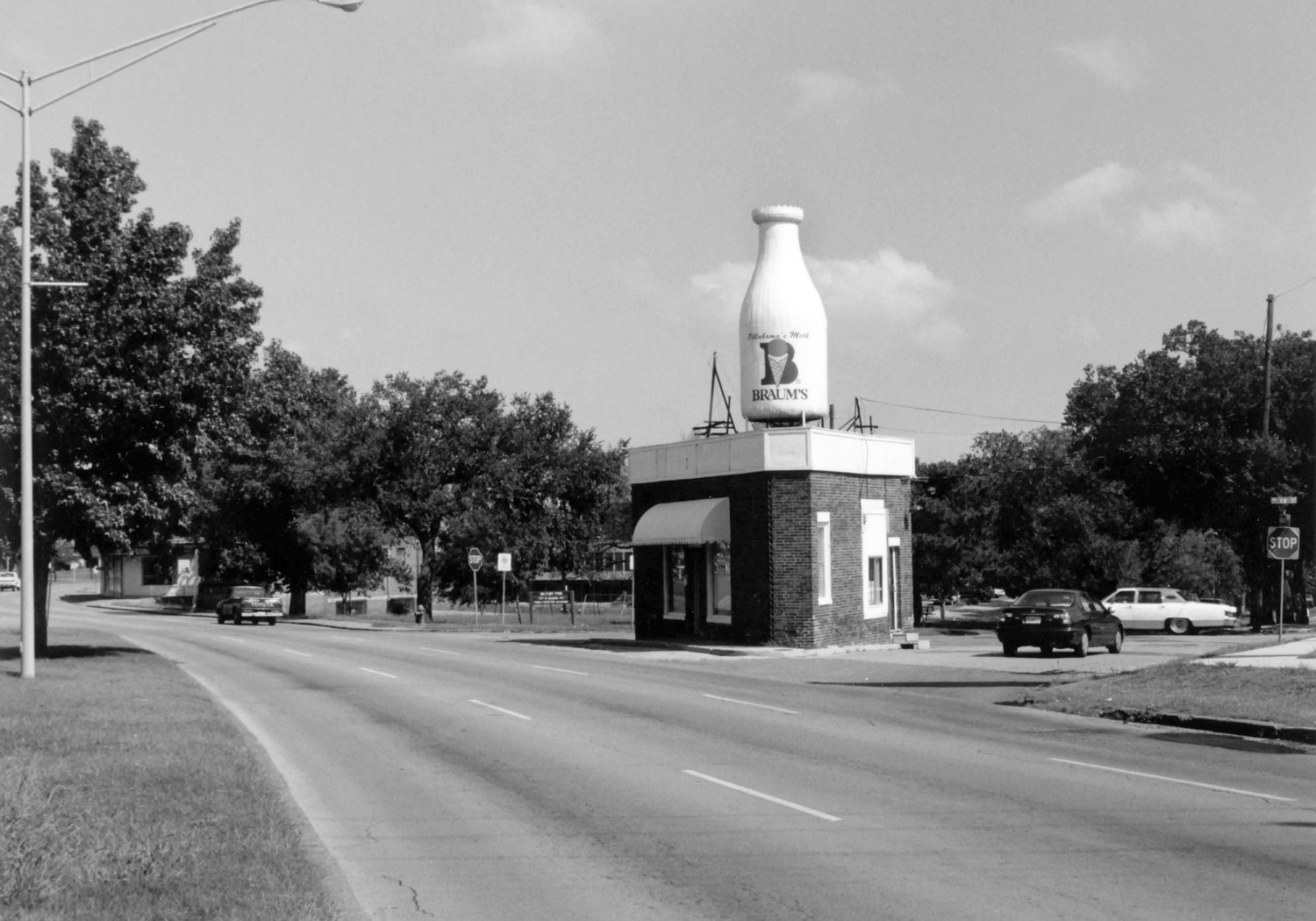
The building was constructed in 1930. With the construction of the giant milk bottle on top of the building in about 1948, the building became known as the Milk Bottle Grocery.
The Milk Bottle Grocery is a diminutive triangular building constructed on nearly every available square foot of a small triangular plot. The shape of the property is a result of the intersection of the Belle Isle street car line with the dominant orthogonal street pattern. The path of the street car line ran diagonal to the street grid. The location of the grocery was a stop on the line, and the street, Classen Boulevard, still has a diagonal jog in that immediate area.
There are few triangular lot-shaped buildings in Oklahoma City. Five triangular shaped buildings of varying sizes have been identified in Oklahoma City, including, the two-story Heierding Building and the two-story Plaza Court building (the (largest triangle building in the capital). East of the Heierding Building is a two-story, buff brick, triangular shaped building. The fifth triangular shaped building in Oklahoma City is at 5801 North Western. This building was built in about 1968. The one-story Milk Bottle Grocery is unique in that it is the smallest of all of these buildings, and it is the only one that features an oversized advertising device as a part of the architecture.
The first listing of the building in the Oklahoma City city directory is for a Cooper Cleaner & Dyer. Subsequent listings for different businesses include the Oklahoma Realty & Investment Company, the Classen Fruit Market, the Triangle Barbeque and, from 1940 until 1948, the Triangle Grocery. The 1949 listing shows the name changed to the Milk Bottle Grocery. This name change is indicative that the bottle was probably added to the original building sometime during 1948.
As Classen Boulevard, the major street that the Milk Bottle Grocery faces, became an increasingly busy commercial thoroughfare, the appeal of advertising to the passing traffic mounted. Window displays would be almost impossible to see from a passing car and there was no room for a free-standing sign. The little building was, and still is, marooned in a sea of vehicular traffic. The only place left on the lot for an advertisement was the roof, and any advertising device at roof height would have to be sufficiently eye-catching to make an impact on passing traffic.
The appeal of roof-top advertising was reinforced when "Classen Boulevard was widened to six lanes about (in) 1950 … ". The widening of the street resulted in an encroachment on the frontage of the property down to the width of a narrow sidewalk and a space for parallel parking.
The idea of using large-scale objects as a direct and literal form of advertising had a precedent in other parts of the country. "The drive-ins of the thirties … recognized that, for a commercial building, advertising is a legitimate function to be expressed in architectural form. To make a relatively small building visible to customers from far down the street, the entire building was conceived as a sign to attract customers. Stands in the shape of fanciful giant objects, animals, fruits, and foods, an architectural onomatopoeia, used bold scale as a design concept … " With the success of any business in the tiny building increasingly dependent upon customers in automobiles being able to identify it from a distance down the street, and because of its proximity to a busy commercial thoroughfare, the Milk Bottle Grocery was an ideal subject for a bold advertising statement.
In the case of the Milk Bottle Grocery, the building was not originally conceived as a sign, but was modified later in an imaginative way that preserved the original building and successfully made the building one of the most recognizable advertising tools in Oklahoma City. Thus, Oklahoma City was graced with a giant milk bottle which continues to be a familiar object of affection to everyone who passes by.
Building Description
The Milk Bottle Grocery is a detached, triangular, Commercial Style brick building built in 1930. It is located in a busy inner city commercial area that is characterized by newer and renovated strip shopping developments. The building is built in the right of way of a major commercial street, Classen Boulevard, in a portion of the street where it cuts diagonally through an orthogonal street layout. The triangular plan is a direct result of the diagonal cut, and the building footprint takes up almost every square inch of the resulting triangle. The outside face of the wall is a few inches from the curb on two sides, and a narrow sidewalk separates the building from the third side, facing Classen Boulevard. Although two windows have been modified with plywood infill, the building has retained a high degree of integrity.
The Milk Bottle Grocery building is one-story, approximately 11 feet tall, and has a triangular plan. The building appears to be brick bearing walls. Exterior brick is laid in a running bond. At two places where exterior brick walls intersect at angles greater than ninety degrees, the bricks are left uncut, with the result that overlapping edges project slightly beyond the wall plane and resulting gaps are left open. The roof is flat. The building is small, with a gross area of approximately 350 square feet. The interior is one small triangular room with a small bathroom at the north end.
The southwest elevation, facing Classen Boulevard, has a central single door flanked by large rectangular fixed windows. Sheltering both the door and two windows is a fabric awning.
The east elevation has a small hung window on the south end and a single door on the north end. The above grade door has two wood steps. The lower step extends just slightly past the curbline into the street. Off-center and just to the south of the door on the east elevation, is a larger window that has been modified with plywood infill and an aluminum pass through window.
The north elevation has two drain spouts and one large asymmetrically placed window completely infilled with plywood.
The building's window and door heads are surmounted by a brick soldier course and the windows have rowlock sills. A plain plywood cornice with horizontal battens at the top and bottom and vertical battens at eight foot intervals caps the building.
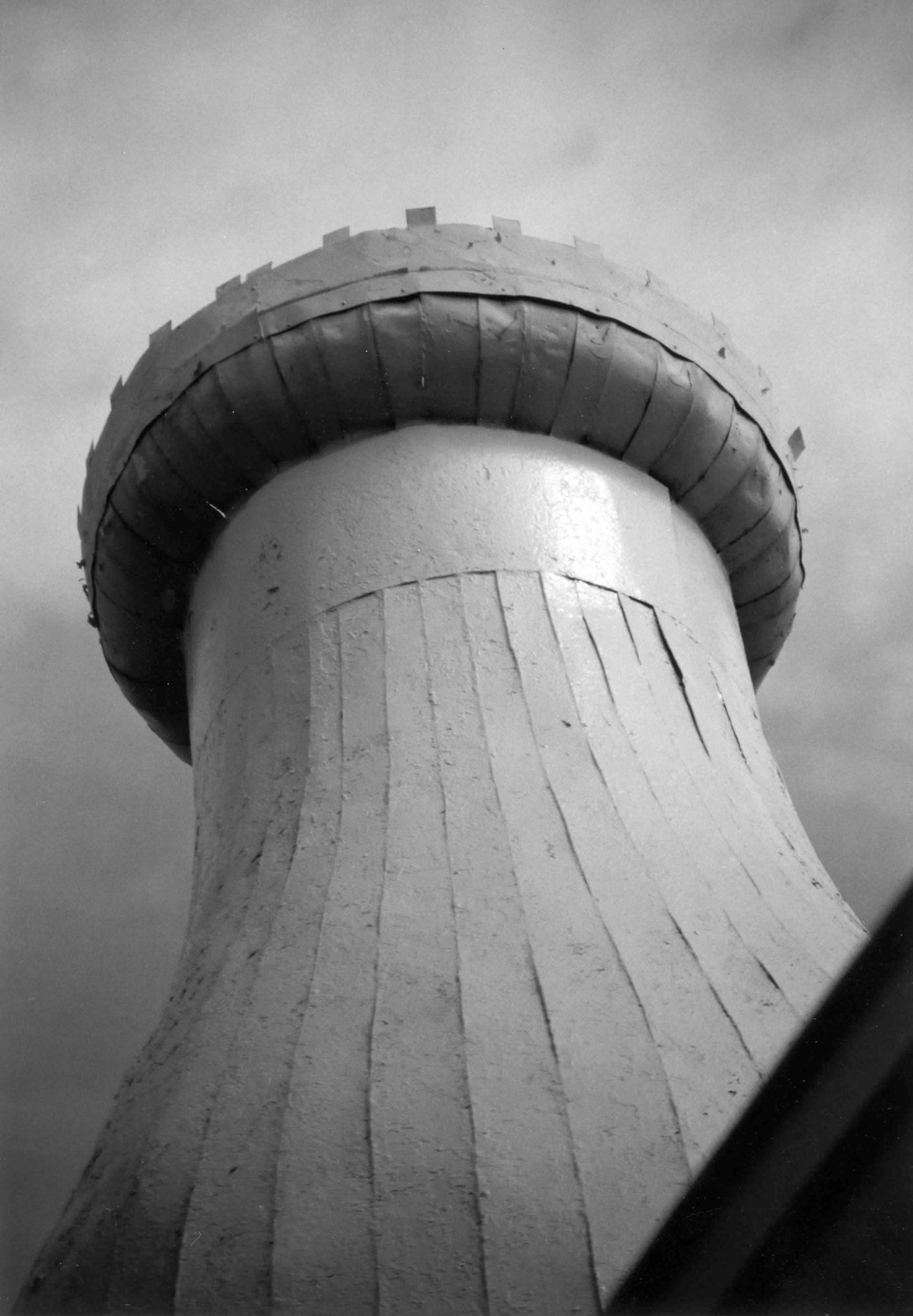
The most noteworthy feature of the Milk Bottle Grocery is a disproportionately large sheet metal milk bottle on a steel angle structure that is located at the approximate center of the rooftop. The sheet metal is riveted, screwed and bolted onto the structure. The bottle is elevated above the rooftop and is a prominent feature on Classen Boulevard. The bottle appears to be approximately eight feet in diameter and almost as tall as the building itself. The bottle is painted white, and a graphic advertisement for a company which sells dairy products is painted on the bottle. Considerable attention was given to the shaping of the bottle and cap. Sheet metal in continuous thin strips was placed vertically to achieve the round bottle shape, a slightly rounded base, a tapered neck, and a rimmed top. The cap has a crenelated configuration at the top that mimics the folded paper caps that were used to close milk bottles.
The milk bottle was not an original feature of the building. From the names of businesses that occupied the building, the milk bottle was apparently added to the original triangular building in about 1948 when it became the Milk Bottle Grocery. Prior to that, the business in the building was the Triangle Grocery and Market. The bottle was and is rented separately from the building for advertising. The present advertisement painted on the bottle is not original; however, it continues a tradition of the bottle being used for advertising by companies which sell dairy products. The previous advertisement on the bottle was for Townley's Dairy, which took over the lease of the bottle from Steffen's Dairy in the late 1950's.
The building's interior was damaged in a fire in the spring of 1993, but the exterior was not damaged. The exterior has undergone only minor modifications. One window has been altered by the infill of plywood and a smaller aluminum pass through window. Another window has been completely infilled with plywood. On both windows, the original headers and sills are still visible.
Facing northeast (1997)
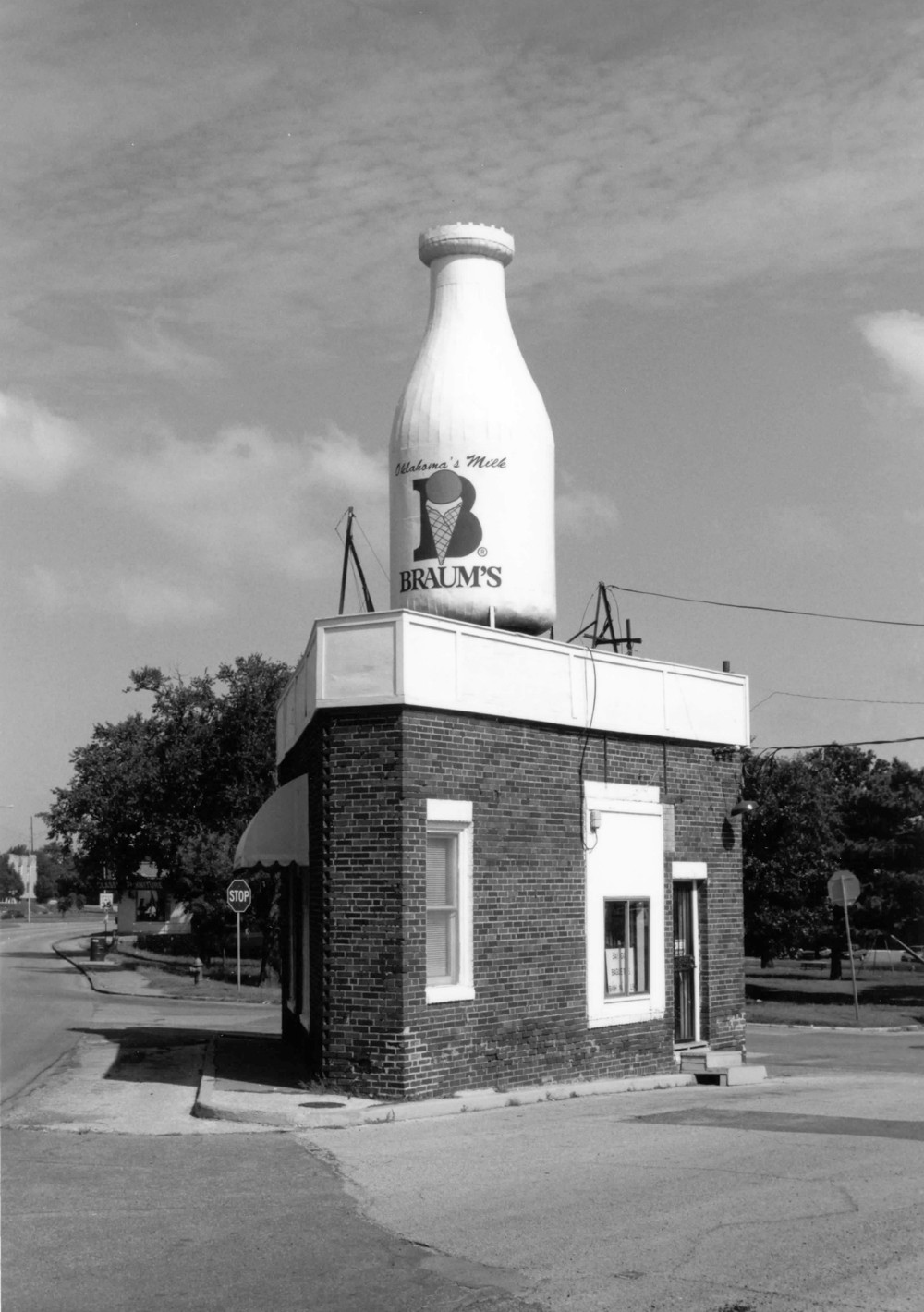
Facing north (1997)
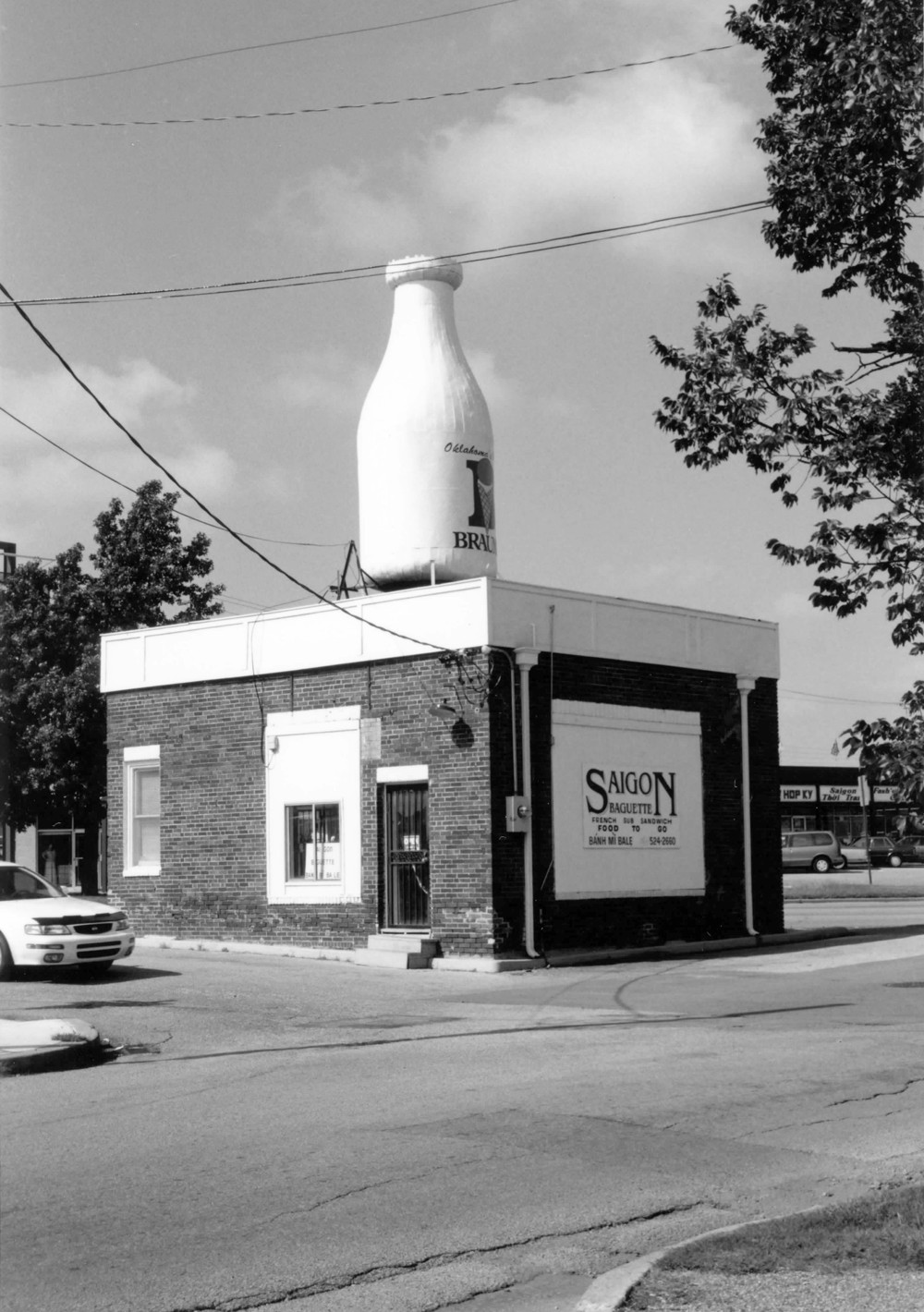
Facing southwest (1997)