
Train station during restoration NY
Truxton Train Depot, Truxton New York


The Town of Truxton's former Lehigh Valley Railroad Depot was built in 1872, in form the building is a typical long rectangle divided into freight and passenger sections, and features a characteristic three-sided bay window for observing the on-coming train on the track side, and a gabled roof supported by prominent decorative brackets. The building is sheathed in board and batten cladding, and trimmed with simple, slightly arched door and window casings. On the interior is an unfinished freight portion and passenger waiting room with beaded board walls and ceilings and paneled doors. The Truxton Depot aided in the development and prosperity of Truxton as an important farming community that reputedly shipped out by rail 80,000 pounds of cheese processed in Truxton on the day the depot opened.
The Town of Truxton is located in the northeast quadrant of Cortland County about twenty miles due south of the City of Syracuse in Central New York. It was named in honor of Commodore Thomas Truxton, commander of the United States' 36-gun frigate Constellation, and was organized within Onondaga County on April 3, 1808. Five days later, Cortland County was formed, when four-and-one-half towns of the Military Tract were separated from Onondaga County, including the new Town of Truxton. The county was named after the first Lieutenant-Governor of the State, General Pierre Van Courtlandt. It is rectangular in shape and measures about 26 miles north and south and about 20 miles from east to west, with an area of 485 square miles.
The land area that now comprises all of Cortland County was originally part of the Military Tract, 1.5 million acres in the center of New York State that were divided into parcels of 600 acres for distribution to Revolutionary War veterans. Twenty-four of the twenty-eight towns in the tract were named for historical figures of ancient Greece and Rome, and drawing for lots began on January 1, 1791. The land was quickly disposed of, some to soldiers, and some to land speculators. The land area that currently comprises the town of Truxton was originally part of the Military Tract towns of Fabius and Solon.
No European-Americans settled in Cortland County prior to the selling off of Military Tract lots in 1791, and the earliest settlements were built along Tioughnioga River, a tributary of the Susquehanna that flows southward through Cortland County. The first settler in Truxton was Samuel C. Benedict, who built a log cabin in 1793.
Like so many early settlers of the area, the first came from eastern parts of New York and parts of New England and New Jersey. Robert McKnight, who bought 550 acres of land in 1799 in Truxton was the first settler to send wheat to market in Albany, over 100 miles away. This event may be the earliest known export of agricultural products from this town, the main industry of which has always been farm products. Around the same time, a gristmill was constructed, and soon after, Steven Hedges, the first merchant in the town, arrived. He also served as Truxton's first postmaster.
In the early nineteenth century, Truxton became home to small industrial pursuits such as a woolen mill, a sash and blind factory, and a carriage shop. There were gristmills, tanneries, wagon factories, blacksmith shops, hardware establishments and the like. But the most important industry in Truxton has always been agriculture. Dairy farms were very important in the community and in the nineteenth century, and there were two cheese factories and a milk depot.
Prior to 1872, the nearest railroad stop to serve local farmers and industries was at Apulia, several miles north of Truxton. In 1869, a group of businessmen from Norwich, Utica, Oswego, Walton and Middletown formed a new railroad called the New York and Oswego Midland Railroad, known locally as the Midland. The railroad went into operation in 1871 and began service to Truxton in 1872, at which time the depot was constructed. The railroad first approached Truxton from the southeast on a spur that traveled from the city of Norwich in Chenango County, but soon after was extended southwesterly from Truxton to the county seat of Cortland County, the city of Cortland. In the late 1870s, the spur between Truxton and Norwich was abandoned and the connection to Truxton was extended northeasterly to Canastota where it connected with the New York Central Railroad.
In 1881, the name of the New York and Oswego Midland Railroad was changed to the New York, Ontario and Western, known as the O & W. This extensive system ran from northern New Jersey to the Lake Ontario port city of Oswego, more than 50 miles north of Truxton and the Truxton depot served part of the O & W line between Cortland and Canastota.
In 1905, the Lehigh Valley Railroad purchased this section of the line from the O & W and operated it for the following 60 years. Chartered in 1853, the Lehigh Valley began in 1846 as the Delaware, Lehigh, Schuylkill & Susquehanna Railroad and was built to transport anthracite coal of the Lehigh Coal & Navigation Company. The Lehigh Valley had several branches in New York State, serving the large cities of Rochester and Buffalo, as well as branches serving smaller cities such as Elmira, Ithaca, and Cortland in the Southern Tier and Finger Lakes region of New York.
One year after the depot opened, Truxton's most famous citizen was born. John J. McGraw, who delivered telegraphs from this station to local farmers when he was a boy, was born in Truxton in 1873. He was third baseman for the Baltimore Orioles in the 1890s and manager of the New York Giants from 1902 till 1932. During the time McGraw managed the Giants, the team won three World Series trophies, ten pennants, and finished second eleven times. McGraw also ranks second in the number of team wins, with 2,840. He was inducted into the Baseball Hall of Fame in 1937, three years after his death.
In recognition of the fact that McGraw never forgot his Truxton roots and was a frequent visitor to his hometown, a baseball game was played in his memory at the John J. McGraw Field, immediately adjacent to the depot, and constructed in large part from donations by McGraw himself. The field, operated to this day as a town park, was the scene of a game between the New York Giants and the Truxton Giants in 1938, and seven thousand people were reputed to have witnessed the game, some watching from the depot.
As rail use declined in the mid-twentieth century across the United States, it declined also in Central New York. In September 1967, the Lehigh Valley Railroad received permission from the Interstate Commerce Commission to abandon the 47 miles of track between Canastota and Cortland, and in December of that year, the last train ran between the two places, thereby ending nearly 100 years of rail service to Truxton. The depot was sold to the Agway Company and used as a warehouse for several years. Eventually the property was purchased by the Town of Truxton, and the current plan is to rehabilitate the historic depot as town offices and a historical museum, thereby returning this long-abandoned building to active use.
Building Description
The Truxton Depot is a small rectangular one-story frame building, measuring approximately 50 feet in length, and 30 feet in width, oriented with its long side facing the former railroad bed. It is located at the end of Railroad Street, a short unpaved road that runs southward from New York State Route 13, the main street in the hamlet of Truxton, within the larger town of the same name. On the opposite side of the former railroad bed is the John J. McGraw Field, a town park and baseball field named for Truxton native McGraw who was inducted into the Baseball Hall of Fame in 1937. East and west of Railroad Street along Route 13 are scattered residences that characterize the small hamlet. The depot is on a parcel of .56 acres.
The depot sits on a full stone foundation beneath the passenger end of the building, and widely spaced stone piers support the freight wing. Typical of such buildings, it is sided with wide board-and-batten siding and capped by a prominent overhanging gabled roof supported by large brackets. The roof is covered with corrugated metal. On both track and street sides, the building is visually divided into two large sections. The eastern half contains the freight room, with one large cargo door as the only opening in that half on both track and street sides of the building. At the lowest level of the wall east of each cargo door is a horizontal board that once provided support for a raised platform that encircled the freight wing. This platform, which was most likely at the height of the floor of a freight car, is visible in a historic photograph of the building but is no longer present.
In the middle of the trackside elevation, separating the freight room from the passenger part of the building is the characteristic three-sided window providing a view of the tracks from the ticket office. Four-over-four window sash, still extant, are also visible in the historic photograph. To the west is a single passenger door and a single window to the west of that. On the street side, there is one large freight door in the eastern half of the facade, and a passenger door and window in the western half. Most windows contain six-over-six sash and are decorated with slightly curved heads and simple wood trim on the exterior. Historic doors are also present in the openings.
The interior of the building is substantially intact. On the freight end, a large unfinished room exists, with a mix of open framing and unfinished wall surfaces, and some of the building's exterior sheathing is visible from the interior in this room. This L-shaped space also provides access via a ladder to the unfinished attic above the passenger side of the building. Taking up the space inside the L is the ticket office, a simple nearly square space completely sheathed in beaded-board paneling and ceiling. On the track side of the ticket office is the three-sided window, and other historic features include a built-in cabinet with shelves, as well as the control board for some of the signals. Some levers that controlled the signals remain in the signal board. A single door provides access between the freight room and the ticket office, and opposite that is a Dutch door between the ticket office and passenger waiting room. Also extant between the ticket office and waiting room is the ticket window. Some remains of the bracketing supporting the counters exist, but the counters themselves are missing.
The passenger area is a large rectangular space that occupies approximately one-third of the building's floor area, extending from the front to the back of the building at its western end. It is entirely sheathed in beaded board paneling with a matching ceiling. Some of the walls of the room are divided by a chair rail, while others are uninterrupted panels painted to appear as if the rail extends all the way around the room. Wall and ceiling surfaces are in good condition. The passenger waiting room doors on opposite walls of the north and south elevations provide access to the tracks and the street. Adjacent to each is a single window on the north and south walls, and there are two matching windows on the west elevation of the building. The historic photograph shows that a level platform once encircled the passenger side of the building, about one step above grade on the track side and several steps above on the street side. The platform no longer exists.
When the track was abandoned and the building closed in 1967, the Truxton Depot was used as a warehouse by the Agway Company. Fortunately, virtually no modifications were made to the building during that period, and in 1991, it was sold to the Town of Truxton for one dollar. The town has decided to reuse the building as its town hall, utilizing the freight room for offices and a restroom, the ticket office as a small museum. A public meeting room for the town board and other groups will utilize in the passenger waiting room.
South and west elevations, looking northeast (2008)

North and east elevation, looking southwest (2008)

South and east elevations, looking northwest (2008)

South elevation, looking northwest (2008)

Passenger waiting room, looking north (2008)
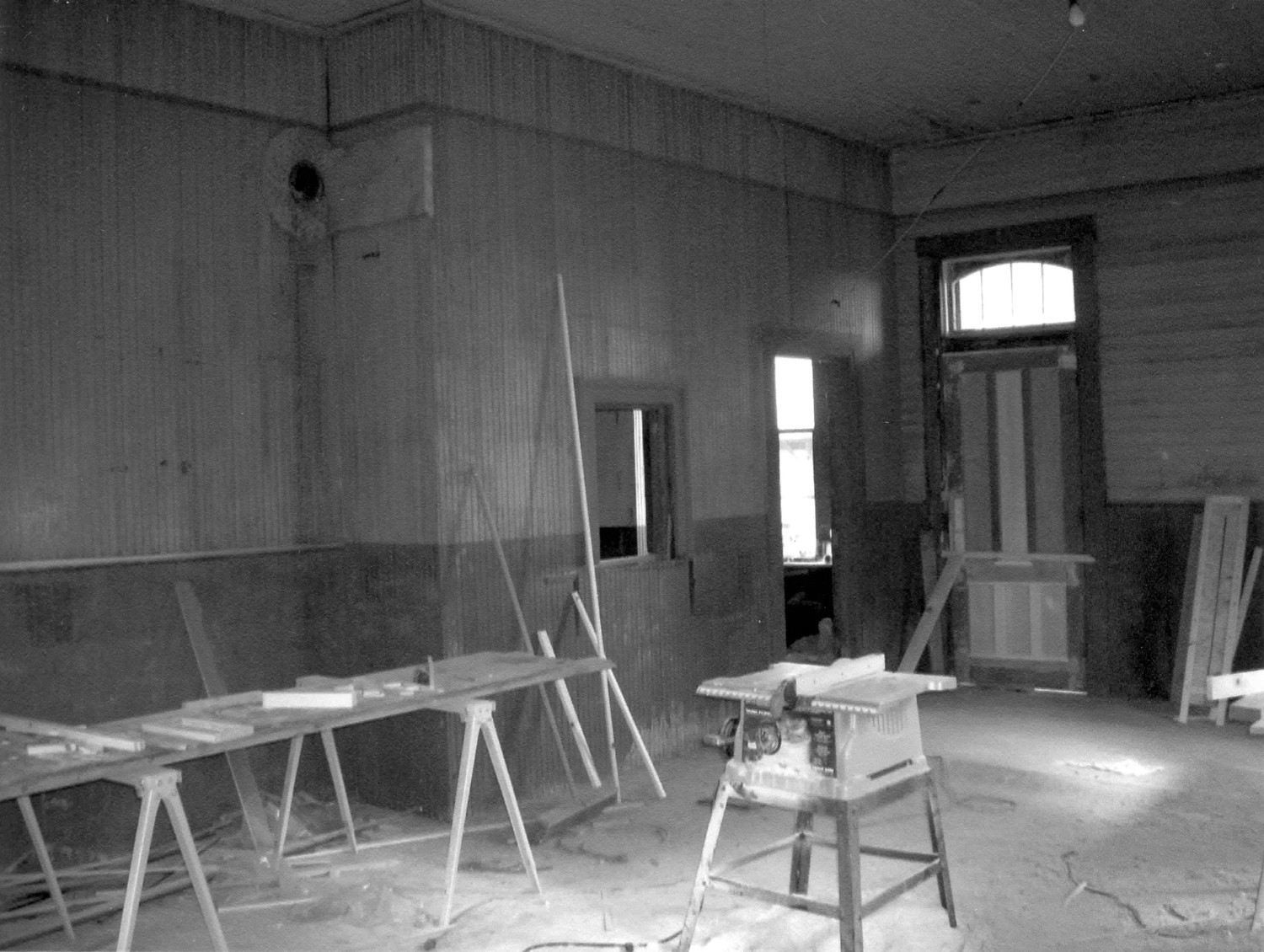
Passenger waiting room, looking southeast (2008)

Ticket office, looking west (2008)

Ticket office, looking southwest (2008)

Ticket office, looking south (2008)

Freight room, looking north (2008)

Freight room, looking northeast (2008)


