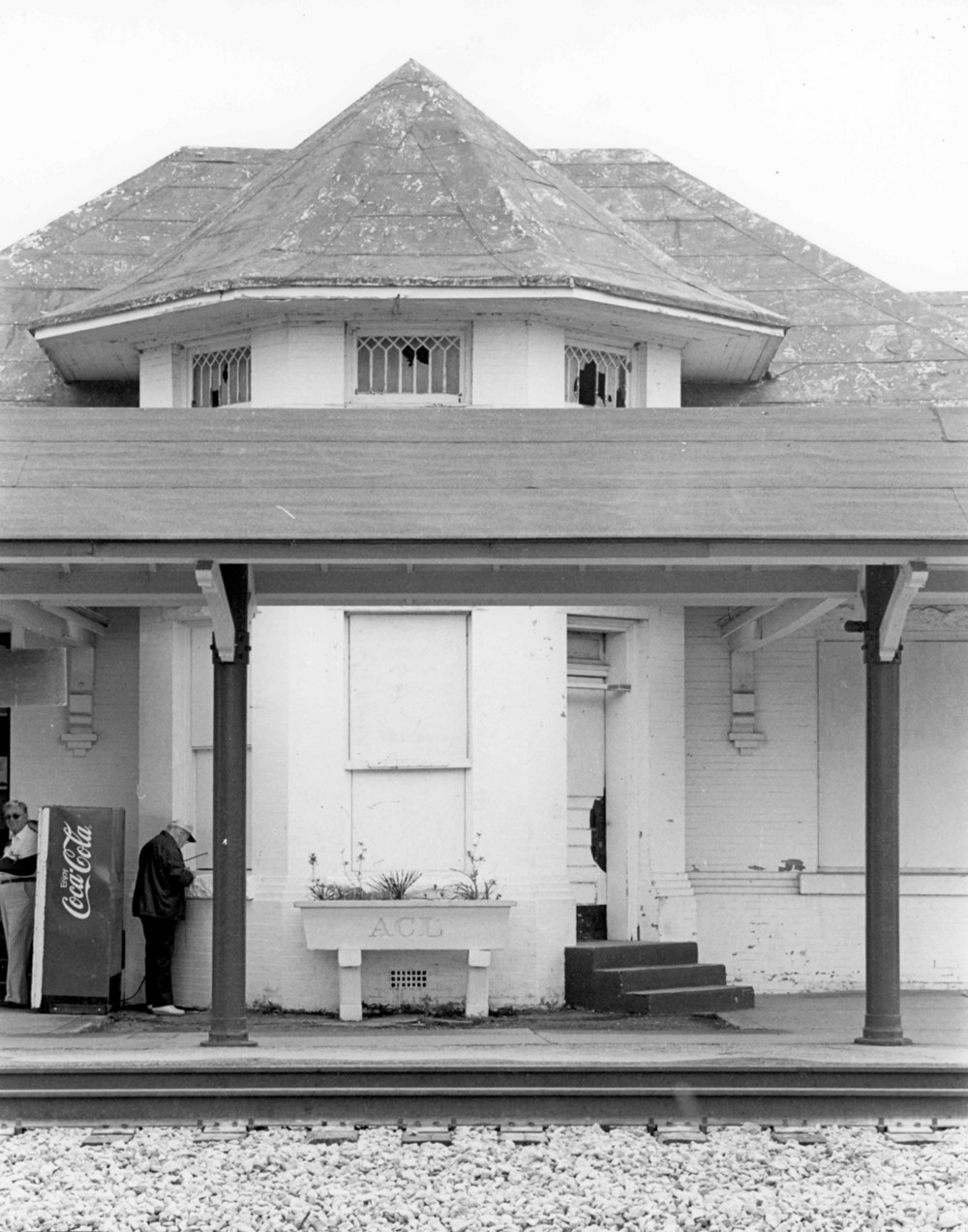
Old Atlantic Coast Line Union Depot, Palatka Florida


- Categories:
- Florida
- Railroad Facility
- Passenger Station
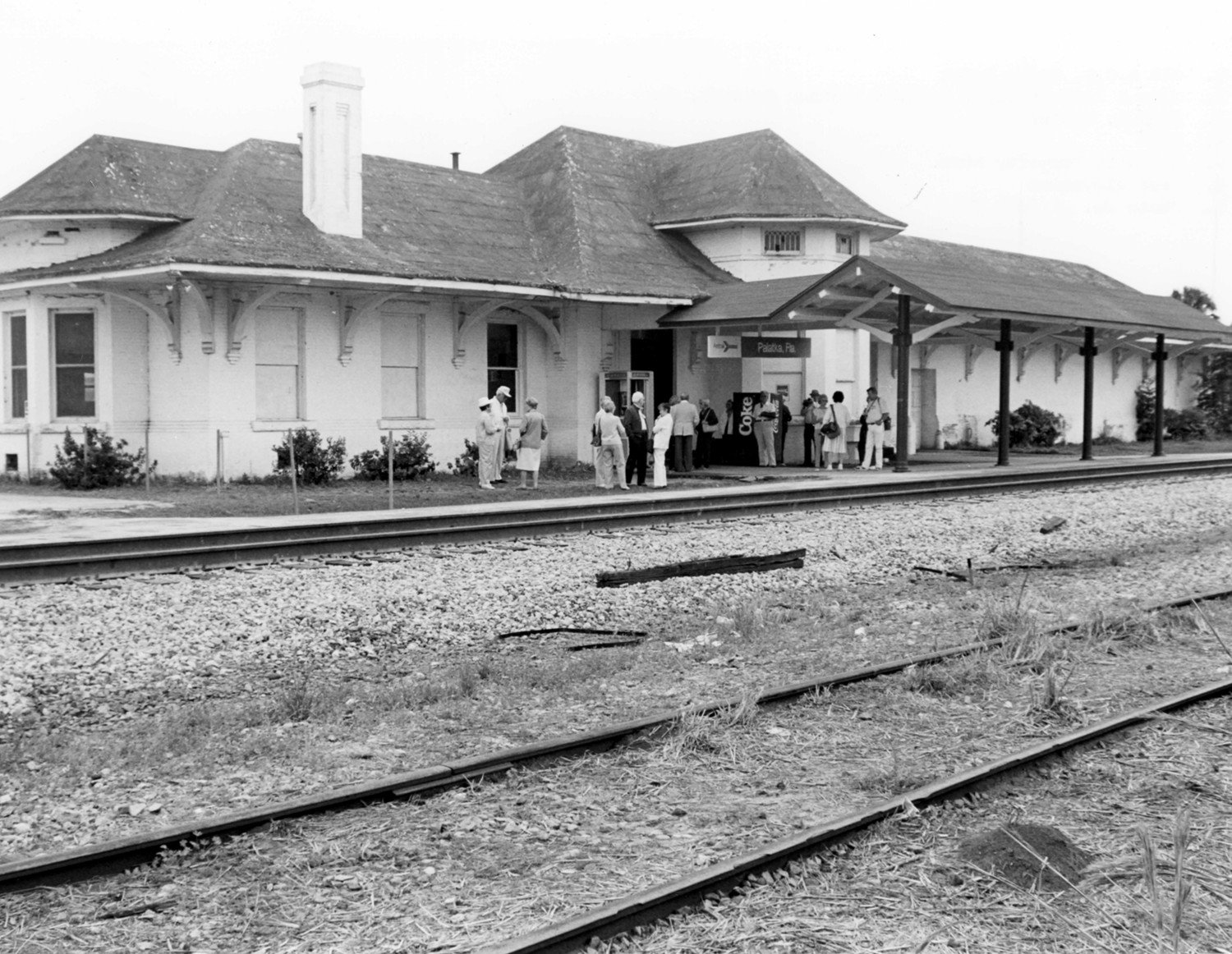
The city of Palatka stands on the west bank in a bend of the St. Johns River. The former steamboat port lies approximately halfway between Lake Monroe, the headwaters of the river, and Jacksonville, about 50 miles north of Palatka, where the river exits into the Atlantic Ocean. The community of approximately 10,000 population stands at a point on the St. Johns River that had long been favored as a river crossing by Indians and later by Europeans shipping their cattle to market. Its role in the colonial transportation network, in fact, is recognized in the genesis of its name, Pilo-taikita, a Seminole-Creek word meaning "boat crossing." The Union Depot, constructed in 1908 by the Atlantic Coast Line Railroad, symbolizes Palatka's importance as a transfer point for freight and good of all types.
After the United States acquired Florida in 1821, American settlers valued "Pilatka," as the site was usually called in the pre-Civil war period, for its location on the St. Johns. South of Palatka the river narrows considerably and becomes shallower as it winds its way toward Lake Monroe. As a result, settlers heading into the interior soon regarded Palatka as the gateway from which they could continue their journey, either overland in wagons or in smaller vessels up the St. Johns or Oklawaha Rivers.
The first American to settle in the area was James Manver, who established a trading post at the river crossing in 1820. In 1821 a group of northern investors began to promote Palatka as a supply center for the development of the Florida interior. The Florida Association, representing about 70 wealthy New York "agriculturists," purchased a 40,000 acre tract of land north and west of present-day Palatka and ran advertisements in northern newspapers to attract farmers and skilled laborers for the establishment of the new settlements in the area. The Association commenced ferry service at Palatka and constructed two pine log buildings, one to serve as a storehouse for supplies in transit and the other as a dwelling for the company's agent. A post office was established in "Pilatka" in 1827.
Growing Indian unrest in the late 1820s and 30s interrupted the development of Palatka. The influx of white settlers into Florida displaced the Seminole Indians who resented being driven from their land by the newcomers. In 1826 the Seminoles attacked plantations along the St. Johns and conducted raids within 20 miles of St. Augustine, causing many white settlers to abandon their homesteads. Hostilities broke out again in 1835, with the Indians conducting large-scale raids throughout Central Florida. Palatka did not escape destruction, for in December of that year Seminoles burned the settlement from which the inhabitants had already fled, seeking refuge in St. Augustine. The United States military eventually gained control of the Florida interior by constructing a series of forts from which to conduct their campaigns against the Seminoles. One of these, Ft. Shannon, was established at Palatka, because of its strategic river location.
Ft. Shannon proved to be a catalyst for the future development of Palatka. The government installation eliminated the Indian threat to the region and attracted civilians to the area, who began to establish businesses and residences. By 1850 Palatka had become a settlement of about 200 persons. The nascent steamboat industry found the St. Johns River and its tributaries perfectly suitable for the low draft and highly maneuverable vessels.
Palatka, as the starting point of ocean navigation in the Florida interior, figured prominently in the steamboat trade, particularly after the state government facilitated overland travel by upgrading the road between Tampa and Palatka in 1843. The growing number of merchants caused the government to repair the old military wharves built during the Seminole Wars and new ones were constructed as well. The future looked promising, so promising, in fact, that optimists claimed that the rapidly-growing community would eventually outstrip the port city of Jacksonville at the mouth of the river.
Palatka had grown large enough by the early 1850s to warrant the establishment of a local government, and the city was formally incorporated on January 8th, 1853. The following seven years were a period of prosperity as Palatka developed an expanding economy based on freight transport, lumber, and tourism. Palatka blossomed in the 1850s as steamboat traffic increased on the St. Johns. Boats regularly plied the waters from Palatka northward to Savannah and Charleston, and southward up the Oklawaha, a tributary of the St. Johns, to Silver Springs. By the end of the decade, Palatka had secured its position as the hub of the transportation network in central Florida, being the major point for export of the cotton, produce, naval stores, and lumber from the state's interior. The population of the city increased threefold during the decade, growing from approximately 200 in 1850 to more than 600 ten years later.
The Civil War undermined the economy of Palatka by closing river traffic on the St. Johns, and the city was occupied by Federal troops in February, 1864. 'This occupation did not contribute to the improvement of the city, as the Federal occupying forces undertook no significant construction. The three decades following the Civil war constitute the "Golden Age" of Palatka.
During this period the community grew from a town into a city. Palatka grew rapidly to 720 inhabitants in 1870. The post-war period saw a resurgence of steamboat traffic on the St. Johns River, and by the mid-1880s seven steamboat lines were operating out of Palatka. The commercial development of citrus farming in the 1870s and 80s promoted new river activity, as did the mining of phosphate in central Florida. Land values increased along the St. Johns as more and more land was converted into orange groves.
The introduction of five major railroad lines into Palatka during the 1880s improved the city's position in the transportation network of the state. Florida was relatively late in developing its railroads. Only two of any importance were constructed before the Civil war: 1) the Florida Railroad which ran from Fernandina on the Atlantic Ocean to Cedar Key on the Gulf of Mexico, and 2) the Pensacola and Georgia Railroad which linked the east coast city of Jacksonville with Pensacola in the western panhandle. Both lines began service just before the outbreak of the war. Florida's most vigorous period of railroad construction began in the 1880s and was made largely possible by two pioneering developers: Henry Bradford Plant and William Morrison Flagler.
These two northern entrepreneurs marveled at Florida's climate and visualized a great future for the state based on the growth of its railroads. The development of the east coast was fostered by Flagler's Florida East Coast Railway, while Plant conceived the "Plant system" to develop the series of rail lines that eventually became the Atlantic Coast Line Railroad. The first and most important of the "Plant System" lines to reach Palatka was the Florida Southern Railway (1881). Palatka served as the eastern terminus of the company and was the location of its business headquarters. The Florida Southern Railroad connected Palatka with Charlotte Harbor and the steamers that sailed to Caribbean and Gulf ports. Another Plant railroad, the Jacksonville, Tampa & Key West Railroad, commenced operations in 1884 and made Palatka the mid-point stop on the Jacksonville-DeLand and Indian River routes.
Other rail lines introduced later in the decade included the Macon and Palatka Railroad (later the Georgia Southern and Florida Railroad), which opened markets in the mid-west as far as Chicago; the St. Augustine-Palatka Railroad; and the St. Johns and Halifax Railroad. The latter two lines were both owned by Henry Flagler and maintained a terminal in East Palatka on the east side of the St. Johns River. They were connected with the Florida Southern line in Palatka after Flagler's Florida East Coast Railway constructed a wooden trestle in 1888 across the river at the foot of Main Street, the first bridge built across the St. Johns River.
The growing importance of Palatka as a railroad center enhanced the city's function as a freight distribution point. A wide range of goods was transshipped through Palatka, the largest railroad facility close to the interior. By the late 1880s, the railroad had eclipsed steamers as the principal carrier of freight. 'The chief virtue of the railroad was speed; a train trip to Jacksonville took three hours less than one by steamer. Farmers shipping perishable produce could move their goods to market more quickly and cheaply by rail. The introduction of the railroads also led to an explosion of the winter tourist trade. The various railroad lines poured crowds into the city for several months each year, filling the hotels and the Oklawaha steamers traveling to Silver Springs to capacity.
Palatka maintained its importance as a transportation center into the twentieth century. When the steamboat era ended, the city retained sufficient service from railroads to remain prominent in freight trade. In 1913, for example, Palatka ranked fourth among Florida cities in the volume of freight traffic, Three lines continued to serve Palatka after 1913, including the Atlantic Coast Line, the Georgia Southern and Florida, and the Florida Fast Coast, giving the city access to major state and northern markets. Several notable improvements were made to the local rail transportation infrastructure, including the erection of the Atlantic Coast Line Depot in 1908, and the completion of a new railroad bridge over the St. Johns by the Florida East Coast Railway in 1925.
Most railroad companies in Florida built their stations rather haphazardly during the period from about 1880 to 1920, owing in part to size of the community to be served and the number of rail lines that might be located there. Often, as older and smaller railroads were consolidated into larger companies, the new corporation was content to use whatever facilities were already available, rather than allocate funds for new terminals. Passenger transportation was usually secondary to freight, so that often few allowances were made for the comfort of rail travelers. The majority of the railroad depots erected in Florida were one-story wood frame vernacular structures, but whether wood frame or masonry they followed approximately the same design scheme.
The usually rectangular structure had a gently-sloping roof with wide eaves to afford some shelter to the passenger and baggage platforms. Sometimes the building had only one waiting room, but more often there were two in the segregated South, one for whites and another for black passengers. The ticket agent and telegrapher's office usually occupied the center of the building and featured a projecting bay on the track side to allow the station master to observe train movements and operate the signals. Attached to one end of the structure would be the baggage and freight rooms. In some cases, however, the freight was stored in a separate structure. Large and bulky items, such as bales of cotton or crates of oranges, were stored briefly in nearby warehouses to await shipment to distant markets. In most cases these secondary buildings have not survived as they were the first to be abandoned as rail transportation dwindled following the Second World War.
Railroad companies sometimes used local architects to design their depots or, as in the case of the Palatka Union Depot, employed the talents of their own engineering departments. The Union Depot was designed by the Atlantic Coast Line Engineering Department at the company's main offices in Wilmington, North Carolina, in 1907. Some improvements to the ticket agents office, chiefly electrical, were designed by G.M. Poley, an in-house architect, in 1916. The Union Depot is a good example of the basic railroad station design and its adaptation to local materials and popular stylistic influences.
The stylistic antecedents of the building are vague, however, as the decorative details are few and the overall design of the building has been subordinated to interior functions. The "Medievalism" of the design, however, appears to have its roots in the Romanesque Revival and Queen Anne styles of a generation earlier and also reflects the aims of the English Arts and Crafts Movement that sought to develop a new "modern" architecture by reemphasizing the "natural" forms of the Middle Ages. This expression is more apparent in the architect's drawings of the elevations than in the present building, as certain features have been lost or masked in later modifications to the structure. The high hipped roof over the central block of the building and the pavilion roof of the ticket agent's bay, plus the massive chimney stacks, latticed windows and brick corbelling all reflect the influence of the Romanesque Revival style. The arches surrounding the open passageway between baggage and express rooms were also typical of the style, but these were lost when the passageway was enclosed, as was the porch on the street side of the depot. Constructed of buff brick that has subsequently been painted, the depot is typical of passenger stations found in many small towns and is identical in some respects to the ACL Union Depot in Live Oak, Florida, built at approximately the same time as the one in Palatka.
Railroad development in Florida had been largely completed by the World War I period and began its decline shortly thereafter. The 1920s and 30s was a period of consolidation and modernization, but few new depots were built after the 1920s, and these were erected mainly in the fast-growing urban centers associated with tourism. After World War II, railroad passenger service declined dramatically in Florida, largely as a result of the development of the interstate highway system and improved state roadways that entailed a declining economic incentive for the railroads to provide passenger service. Only Amtrak now provides such service to the major metropolitan areas, and many rail lines have been officially abandoned, their rail having been pulled up and their rolling stock and other appurtenances disposed of as surplus.
The Atlantic Coast Line Railroad combined with the Seaboard Air Line in 1967 to form the Seaboard Coast Line Railroad. In recent years, the S.C.L. became one of the family of lines owned by the CSX Corporation, the successor to the Atlantic Coast Line Railroad, and in 1986 the City of Palatka purchased the building to redevelop it and the surrounding site as a community center. Such activity seems to be the only means for saving many of the depots in Florida, even in those where rail service, in the form of freight shipment, at least, still exists, as the old passenger depots are now only a liability to the railroad companies.
Building Description
The Old Atlantic Coast Line Railroad Union Depot at 200 N. 12th Street in Palatka, Florida, was constructed in 1908 and is a one-story, brick-walled, masonry vernacular structure located approximately one-half block north of the intersection of Main and North 12th streets. Main Street is Palatka's busiest east-west traffic artery. At its base, the building measures 167' X 58'. The building rests on a foundation of 40" X 40" brick piers, with spread footings, that stand on poured concrete bases. The seventeen-inch thick, load bearing brick walls have been sheathed in a veneer of buff-colored brick that has been painted white. The veneer has been laid in American or "common" bond, all of the courses being stretchers except every sixth, which is a header course.
The basically rectangular plan building is composed of three major sections: a central block, which originally contained segregated waiting rooms separated by a vestibule and the ticket agent's office, and the north and south wings. The north wing featured an extension of the white waiting room, a "ladies' parlor," and the men's and women's restrooms. The south wing contained the black men's and women's restrooms, plus the baggage and express freight rooms. With the advent of integrated facilities, the black waiting room was closed and converted into additional office space for railway personnel.
On the east or street facade of the structure, one finds what was originally an open rectangular porch, the dimensions of which are 21' x 18'. The brick porch was enclosed during the 1950s to provide additional office and storage space. On the north and west elevations are faceted bays that project from the main wall. The north bay provided further windows to illuminate the "ladies parlor," but the west bay was used by the station master and telegrapher to view the movement of trains and operate the signal switches.
The depot is covered by a large hip roof which is somewhat higher over the wings. The roof slopes gently to the wide eaves which project eight feet from the exterior wall and are supported by wooden brackets, the bases of which rest on brick corbels. There is also a hip roof with bracketed eaves over the former porch and the "dormers" over the faceted bays feature pavilion roofs. The dormer over the telegrapher's bay has a small lattice-mullioned window in each of its three forward-facing facets. The north dormer does not have any windows. The clay tiles that originally covered the roof have been removed, and it is now surfaced with rolled asphalt. Current renovation plans include once again covering the roof with clay tile. The depot has two brick chimneys with corbelled caps that rise above the roof. The depot apparently once had two others that were removed.
At present, the east facade is divided into eleven bays; originally there were sixteen, including the one-bay porch. When the office and freight areas were expanded in the 1950s and 60s, a number of the windows, plus the arched entrances of the passageway between the baggage and express rooms, were enclosed. The south wing of the east facade appears to have lost six of its windows. Two of these near the central block were removed when a new freight door was added, and one in the central block itself, just south of the enclosed porch, was replaced with a doorway. The north wing reflects similar changes. A doorway where a window was once found stands immediately north of the porch, and a similar doorway replaced a lattice-mullioned window near the northeast corner of the facade. In most cases, however, the enclosed windows still retain their rusticated limestone lintels and sills.
The west elevation has fared somewhat better than the east, for the north wing and telegrapher's bay still retain their original windows and doorways, as does the faceted bay on the north end of the depot. All but one of the windows on the south wing, however, have been enclosed with masonry, and one of the windows on the south end of the building has been replaced with a freight door. The majority of the original windows were 1/1 light, double hung sashes, while small lattice-mullioned windows were found in the telegrapher's dormer and a few other locations in the east and west elevations.
The concrete walkway or platform between the depot and the railroad tracks is sheltered by a wooden shed with a pent roof supported by metal columns. It is unclear whether this shed was once longer as certain features of the depot do not appear to have been completed exactly as indicated in the architect's plans. Distinctive stylistic and decorative details on the building are few. The structure features some brick corbelling and rusticated limestone lintels and sills, plus the carved wood brackets that support the eaves. One of the most notable and whimsical elements, however, is the free-standing planter with the initials "ACL" that stands in front of the telegrapher's bay.
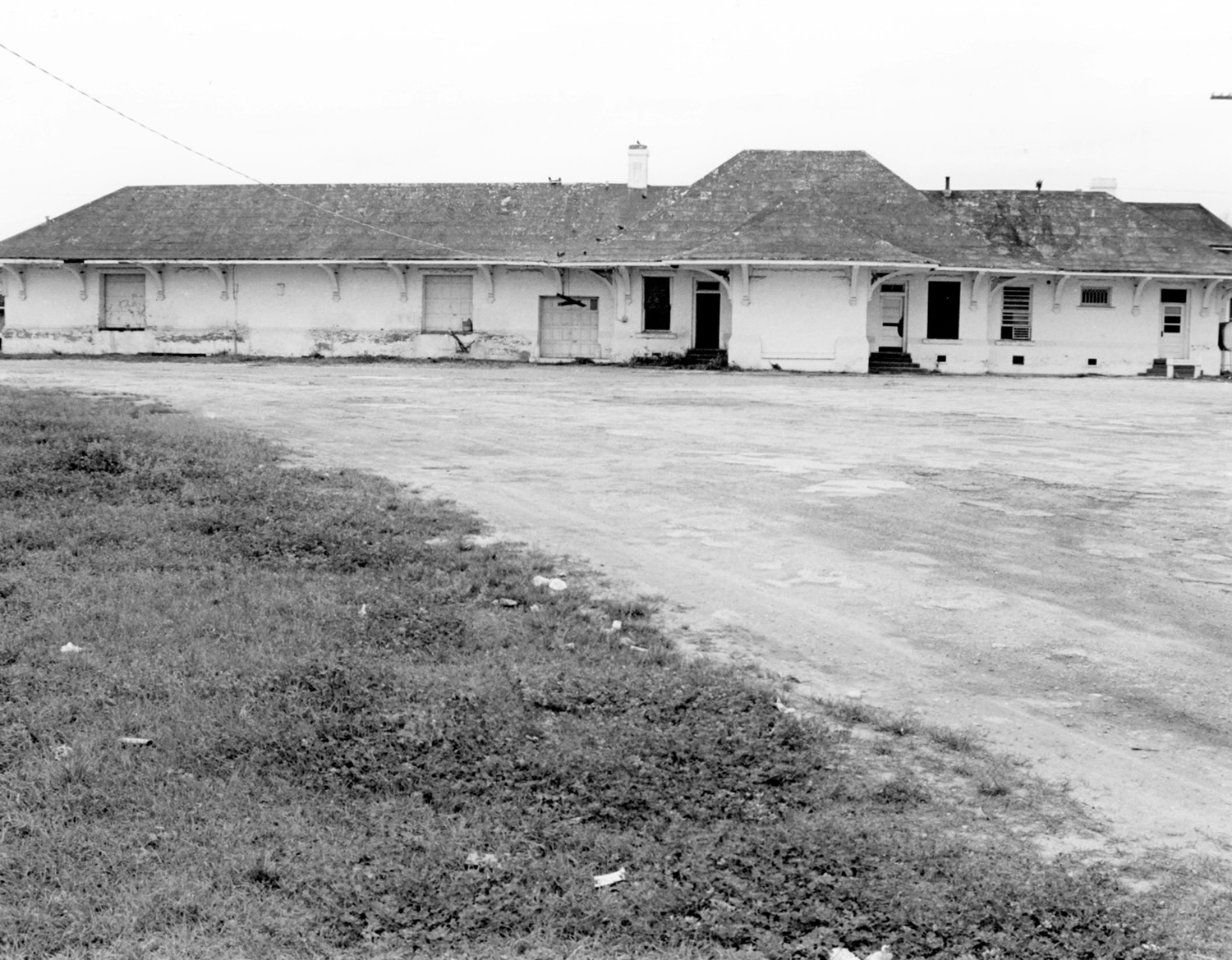
East Facade (1987)
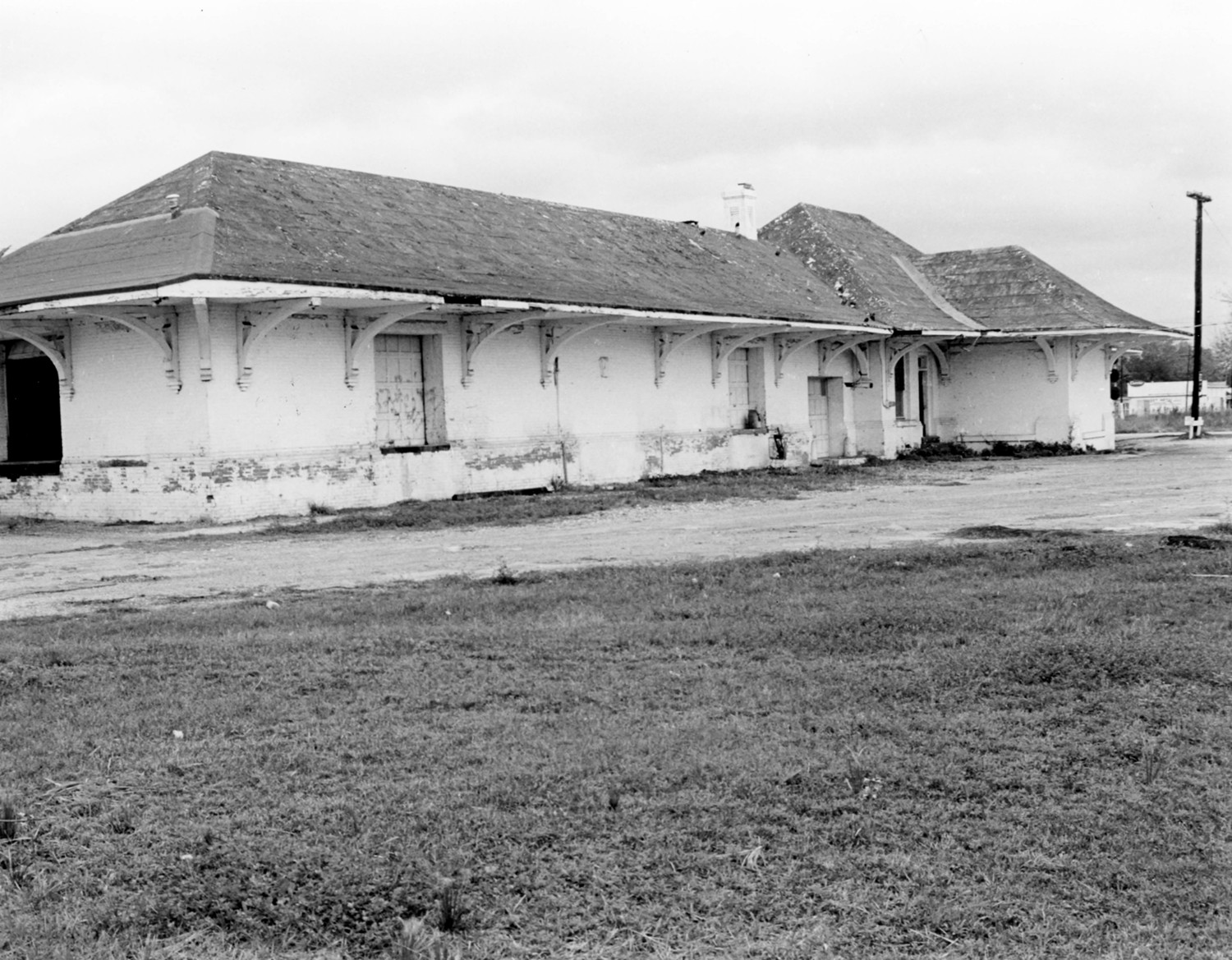
East Facade & South Elevation (1987)

North & West Elevation (1987)
West elevation (1987)