
Sonoma Depot, Sonoma California


- Categories:
- California
- Railroad Facility
- Passenger Station
- Freight Station
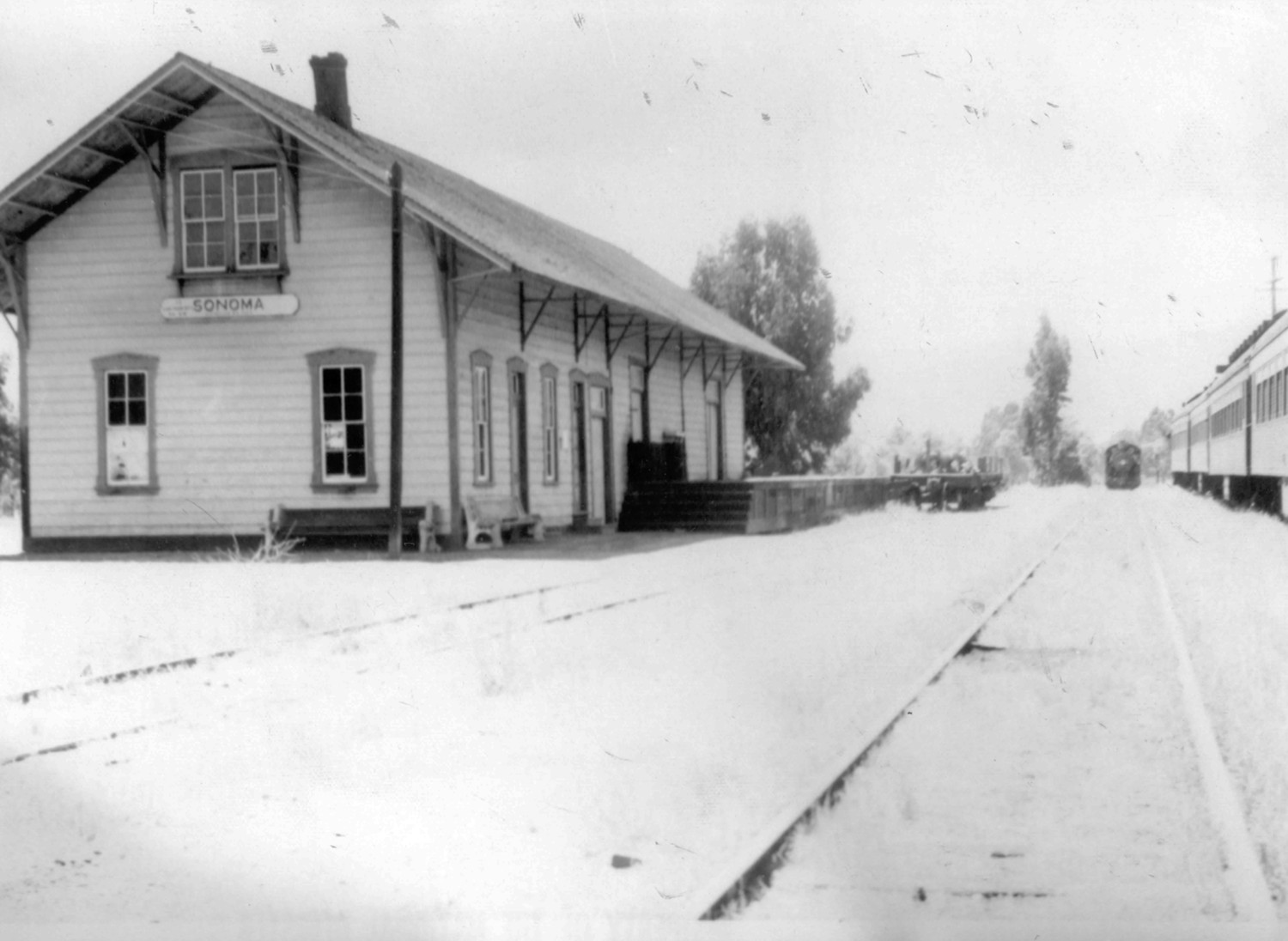
As far as we know, Sonoma Depot is one of the oldest depot structures remaining in California. There may be some remote stations in northern or central California that are older, but this building certainly can be classified as one of the oldest.
This building was built around 1875-76. It was originally built on the Plaza to service the narrow gage railroad, and early photographs show it at the northwest corner. It was moved to the present location around 1890, when there was considerable pressure from citizens in the Sonoma area to get the railroad off East Spain Street and the Plaza. It was altered at some time after its removal to its new location by an extension of the freight house section of the building.
This building epitomizes the first stage of industrial growth in rural California with the introduction of the railroad into the economy of the State. The entrance of the railroad into the Sonoma area and the Valley of the Moon allowed shipment of cattle and production of the basalt quarries directly to the San Francisco market. It also functioned at that time as a passenger carrier for a direct connection to San Francisco via Sausalito. Because of its unchanged condition and closeness to the other historic buildings in Sonoma, it remains untouched as an example of the commerce and industry in 19th century and early 20th century California in agricultural areas. Because of its unusual site and environment, it has remained unchanged from the earliest period. It was undoubtedly a significant element in the growth of Sonoma and the Valley of the Moon after the construction of the railroad in the 1870s.
Railroad operations began in 1879 with the construction of the Sonoma Valley Railroad. This line, built from the edge of the bay to Sonoma in 1878, reached Glen Ellen, California, about a year later. Subsequently, it was extended to Ignacio in Marin County for connection with the San Francisco and North Pacific Railway. The railroad was built by local interests, but Peter Donahue, the builder of the San Francisco and North Pacific, seeing the advantage of the line took control in the 1880s.
The original station and the yards were in the northwest corner of the Sonoma Plaza. The line was originally narrow gauge (3 feet) but was converted to standard gauge in 1890. When the conversion was made the route through Sonoma was moved to the north through purchase of right-of-way by local Sonoma citizens who, although wanting a railroad, did not feel the Spain Street and the Plaza was the best location. There was both passenger and freight service on this line, one of the major freight items being basalt cobblestones for San Francisco street paving.
The station building, as it now stands, has the same general appearance it had in the late 1880s. Early views of the station show a loading dock on the end of the building rather than on the side as is now the case. This building is probably one of the oldest railroad stations now extant in California and is typical of the many frame structures built in the initial stages of railroad construction in California.
When this structure functioned as a standard railroad depot it was divided into three sections, an office area for the agent, a waiting room for the passengers and a freight storage area for receiving and dispatching less than full car loads of freight as well as handling express items.
The building appears to be built from redwood and is otherwise in sound condition. The electrical wiring has been removed by the railroad, as have the Plumbing fixtures. The building is substantially as it was when it operated as a depot, with the exception that the interior furnishings of the station agent's area have been removed, including the counter. However, the heavy scales in the freight section are still in place. It is interesting to note that the loft space above the depot, which apparently was used for storage or possibly as an intermittent sleeping room for the agent, has apparently remained untouched since the early 1900s, as evidenced from newspapers placed on the wall. The building has a wooden shingle roof.
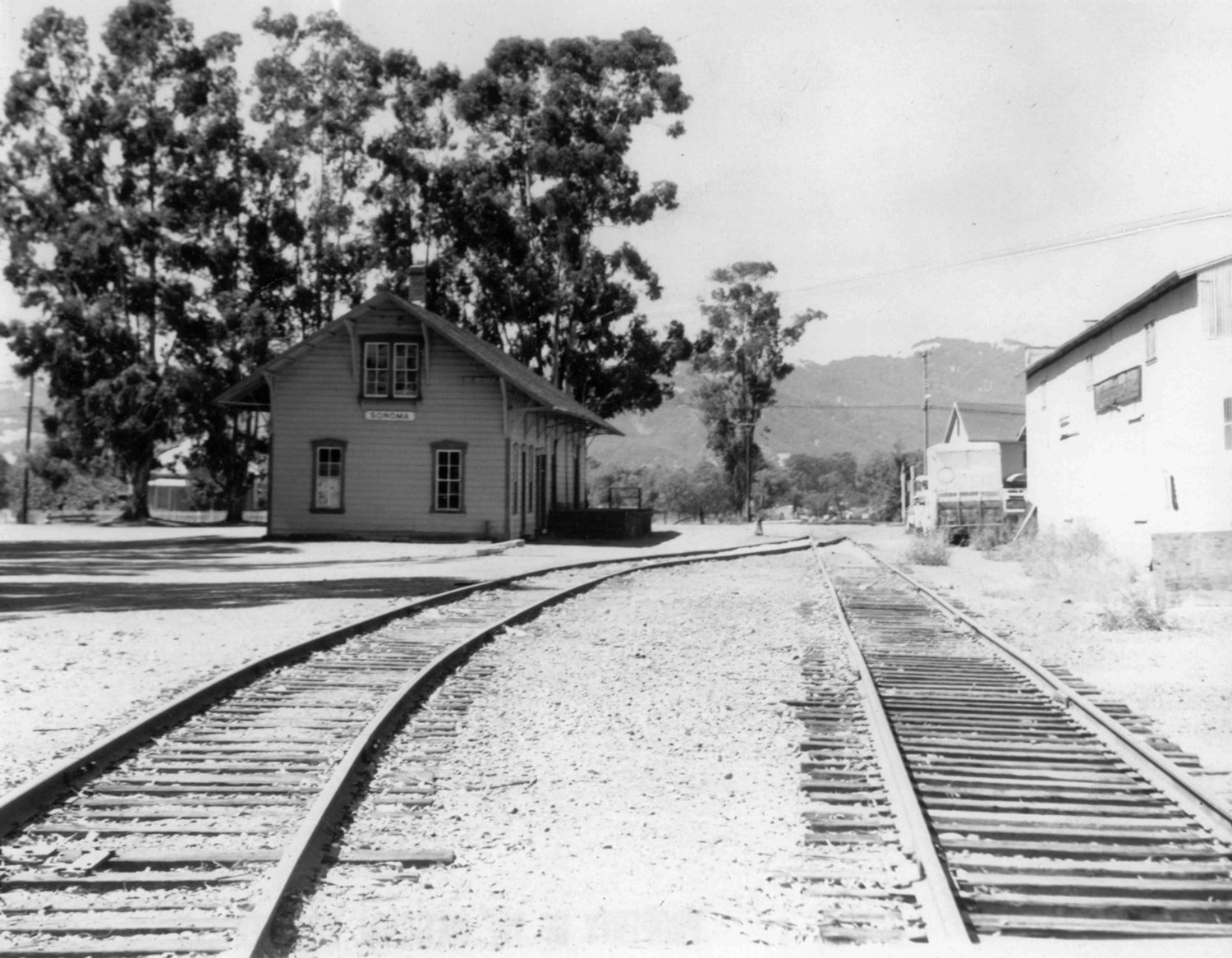
(1975)

(1975)


