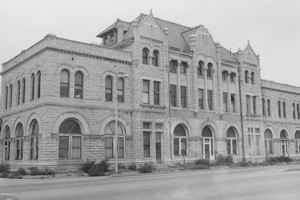
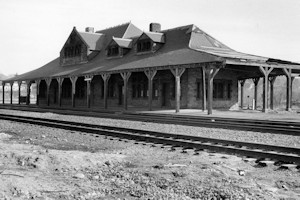
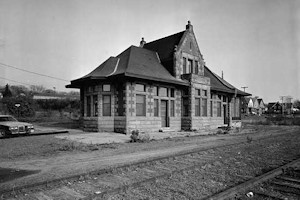
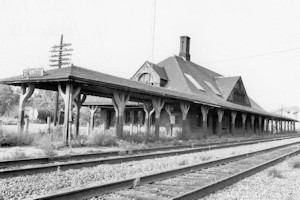
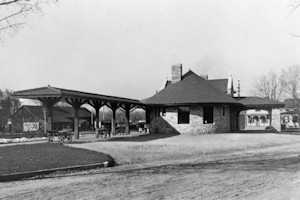
The Troy & Greenfield Railroad Company began railroad service to Williamstown in 1859. The station was a small, frame structure, located approximately on the site of the present station. Use of the station increased after the opening of the Hoosac Tunnel in 1875, after which the station was used as a base for prioritizing the order in which trains might enter the tunnel from the west.
To accommodate the station's expanded role, the new owners, the Fitchburg Railroad Company, laid new track and constructed a quarter-roundhouse and a freight yard nearby. In 1897, they announced plans to renovate and modernize the station. Before such plans could be implemented, however, the station burned to the ground. Construction of the existing station began quickly afterward, with the new station opening to the public on February 21, 1899.
More...
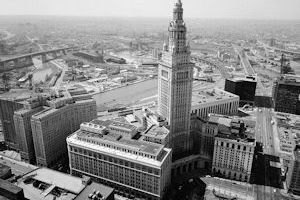
Denver was founded on the dreams of gold discovery, but Denver's early settlers realized that the establishment of railroad traffic was the key to a stable prosperity for the city. When the Union Pacific Railroad chose to bypass Denver and go through Cheyenne, Wyoming, on its transcontinental route, Denver businessmen organized and raised funds to bring the Kansas Pacific into Denver. At the same time, John Evans, Colorado's second territorial governor, convinced Congress to agree to a 900,000 acre land grant for the Union Pacific on the condition that it would connect the Kansas Pacific and the Union Pacific. Thus, the first Union Pacific train arrived from Cheyenne In June 1870, and the first Kansas Pacific train arrived from Kansas two months later.
By 1890, 4,176 miles of track were in use in Colorado. Denver was the focus of rail activity in the region. As the rail lines converged in Denver, so did the wholesalers, warehousers and merchants. Goods were shipped in, primarily from the east, and shipped out to all parts of Colorado. Smelters moved from mining towns to Denver. "Labor was more plentiful, ores could be brought in by rail from several mining communities, fuel could be hauled there more cheaply, and the refined gold, silver, and copper could be shipped out efficiently."
More...
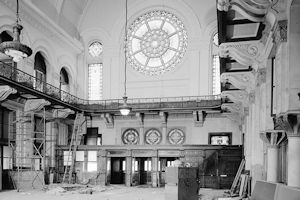
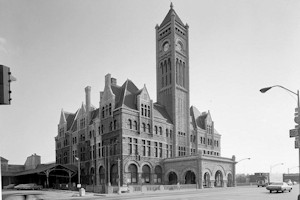
Green Island is located at the confluence of the Mohawk and Hudson Rivers due west of the city of Troy. It was connected both to Troy and to more islands at the north of Waterford by bridges constructed in 1835 by the Rensselaer and Saratoga Railroad Company. LeGrand B- Cannon, who owned much of Green Island, was active in the management of the R&S. In December 1868, the railroad purchased more than 21 acres of the north central portion of the island from Cannon as a site for extensive locomotive repair and car-building and repair shops.
Begun in 1871, according to the builder's stone on the south face of the main building, the Rensselaer & Saratoga's Green Island Shops were completed the following year. By that time the company had been leased in perpetuity to the Delaware & Hudson Canal Company. (All R&S properties have subsequently been operated by the D&H, although the charter of the Rensselaer & Saratoga extends to January 1, 2500.)
More...
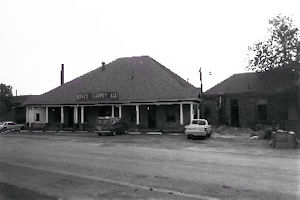
Moffat Station, Denver Colorado
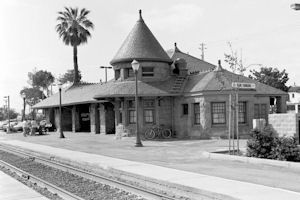
Littleton Denver and Rio Grande Western Depot, Littleton Colorado
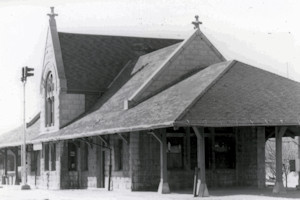
Lehigh Valley Railroad Station, Cortland New York
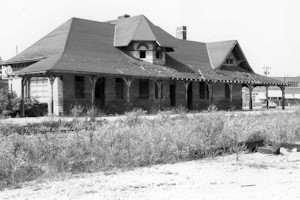
Delaware Lackawanna and Western Railroad Grossing Guard House, Cortland New York